No terms match. Try a shorter word or clear your search.
A
Autolyse
Dough & mixing
A rest after mixing flour and water, before adding the remaining ingredients. It gives the flour time to absorb water and starts developing the dough’s structure.
In the strict version, salt and yeast or starter are added afterward. A rest with all ingredients mixed in is a different method.
See also Gluten · Extensibility · Preferment
King Arthur: Autolyse B
Baker’s percentage
Dough & mixing
An ingredient’s weight expressed as a percentage of the total flour weight. Flour is always 100%.
With 500 g flour, 10 g salt is 2%. These percentages do not need to add up to 100%.
See also Hydration · Scaling
King Arthur: Baker’s percentage
Bench rest
Dough & mixing
A short, covered pause between handling or shaping steps that lets dough relax.
If dough keeps pulling back while you stretch it, a rest may make shaping easier.
See also Elasticity · Dough ball
Biga
Fermentation
An Italian preferment made with flour, water and a little commercial yeast, usually without salt. In pizza recipes, it commonly means a relatively stiff preferment.
Consistency varies: follow the recipe rather than assuming every biga uses the same hydration.
See also Poolish · Preferment
King Arthur: Preferments
Boiling / kettle boiling
Bagels & malt
Cooking shaped bagels briefly in hot water before baking. This sets the outside and helps create their characteristic crust and chew.
Boiling time and additions such as malt syrup depend on the recipe.
See also Gelatinization · Malt syrup
King Arthur: Bagel shaping & boiling
Bulk fermentation
Fermentation
The stage when dough ferments as one batch before it is divided into individual pieces.
“Bulk” describes the undivided batch, even if you are making only a few pizzas or bagels.
See also Fermentation · Proofing
King Arthur: Yeast baking C
Cold fermentation
Fermentation
Letting dough ferment in the refrigerator. Cooler temperatures slow yeast activity and extend the schedule.
Dough continues changing in the fridge. Time, temperature and yeast quantity still matter.
See also Retarding · Fermentation
Cornicione
Pizza & baking
The raised outer rim of a pizza. The word is often used when talking about Neapolitan pizza.
For a puffy rim, leave an outer border when pressing out the center.
See also Oven spring · Crumb
Crumb
Pizza & baking
The inside texture of a baked crust, bread or bagel, including the size and pattern of its air pockets.
“Open crumb” means larger, more irregular holes. Bagels usually have a tighter crumb than airy pizza crusts.
See also Gluten · Oven spring
D
Diastatic malt
Bagels & malt
Malted grain powder with active enzymes that help break starch into sugars. It can affect fermentation and browning.
Use the amount specified by your recipe. It is not interchangeable with non-diastatic malt, and more is not automatically better.
See also Non-diastatic malt · Yeast
King Arthur: Diastatic malt
Docking
Pizza & baking
Making small holes in dough with a fork or a docking roller to limit large bubbles during baking.
Common in some thin, crisp styles. Docking the rim works against a puffy cornicione.
See also Cornicione · Par-bake
Dough ball
Dough & mixing
An individual portion of dough shaped into a round before its final rest or shaping.
Its weight influences how thick a pizza will be at a given diameter.
See also Scaling · Bench rest
E
Elasticity
Dough & mixing
Dough’s tendency to spring back after being stretched.
Strong pullback is elasticity at work. A covered rest can help dough relax.
See also Extensibility · Bench rest
King Arthur: Autolyse
Extensibility
Dough & mixing
How easily dough stretches without tearing.
Good shaping needs a balance: enough stretch to open the pizza and enough strength to hold together.
See also Elasticity · Gluten
King Arthur: Autolyse F
Fermentation
Fermentation
The activity of yeast and, in sourdough, bacteria that changes dough over time. Yeast produces gas that helps dough rise; fermentation also develops flavor.
Rising is a visible result of fermentation, but fermentation is more than just an increase in size.
See also Bulk fermentation · Proofing · Yeast
King Arthur: Yeast
Frico
Pizza & baking
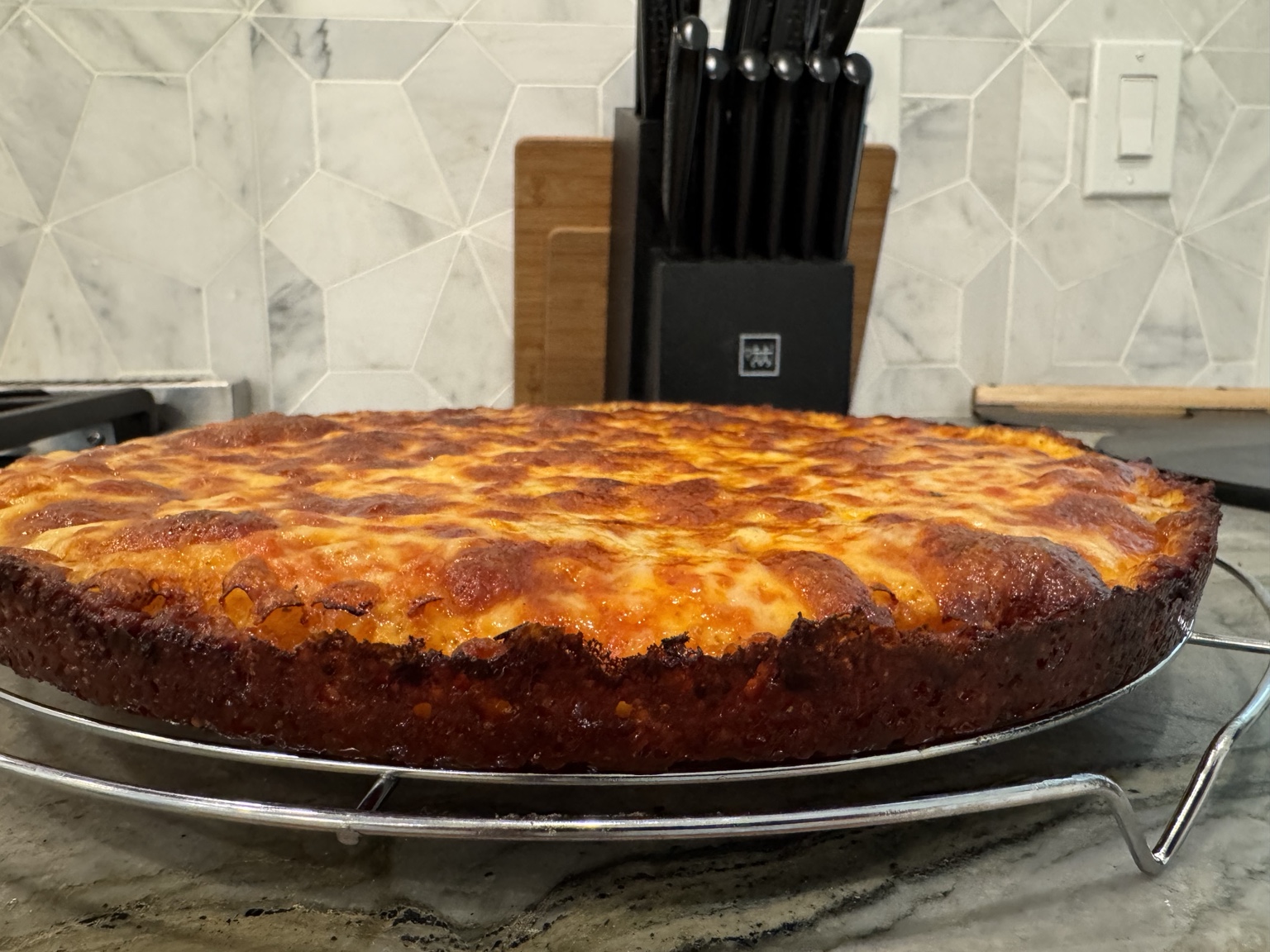
In pizza-making, the crisp, browned cheese edge that forms where cheese meets a hot pan.
Often called a cheese crown on Detroit-style pizza. It is browned cheese around the crust.
See also Cornicione
Ooni: Detroit-style pizza G
Gelatinization
Bagels & malt
The change that happens when starch takes up water and swells as it heats.
During a bagel boil, this helps set the surface. The inside finishes cooking during baking.
See also Boiling / kettle boiling
Gluten
Dough & mixing
The stretchy protein network that develops when wheat flour meets water and the dough is worked. It helps hold the gas that makes dough rise.
Flour choice, mixing and rest all influence dough strength.
See also Kneading · Windowpane test
King Arthur: Yeast baking H
Hydration
Dough & mixing
Water weight divided by total flour weight, multiplied by 100. It tells you how much water a dough contains relative to its flour.
325 g water ÷ 500 g flour × 100 = 65% hydration. Include flour and water inside any preferment. Oil does not count as water.
See also Baker’s percentage · Preferment
King Arthur: Baker’s percentage K
Kneading
Dough & mixing
Working dough by hand or mixer to develop its structure and distribute ingredients.
The goal is suitable dough strength, not a universal number of minutes.
See also Gluten · Stretch and fold
King Arthur: Yeast baking L
Launch
Pizza & baking
Sliding a prepared pizza from a peel onto the hot baking surface.
A pizza should move freely on the peel before you try to launch it.
See also Peel
Levain
Fermentation
A portion of sourdough culture prepared for a particular dough. Recipes may also use the word more broadly for sourdough starter.
Use the hydration and maturity called for in the recipe.
See also Sourdough starter · Preferment
King Arthur: Preferments M
Malt syrup
Bagels & malt
A thick, sweet syrup made from malted grain, commonly barley. Bagel recipes may use it in the dough or boiling water for flavor and color.
Use the type specified. Syrup and powdered malt have different water contents and are not automatic gram-for-gram swaps.
See also Diastatic malt · Non-diastatic malt
King Arthur: Bagel shaping & boiling N
Non-diastatic malt
Bagels & malt
Malt used for flavor, sweetness and color without the active starch-breaking enzymes of diastatic malt.
Check the label: “diastatic” and “non-diastatic” describe different jobs in a recipe.
See also Diastatic malt · Malt syrup
King Arthur: Non-diastatic malt O
Oven spring
Pizza & baking
The expansion of dough early in baking, before its structure sets.
Gas expands and water becomes steam, helping a pizza rim puff up.
See also Cornicione · Proofing
P
Par-bake
Pizza & baking
Baking a crust partway, then finishing it in a second bake, often after adding toppings.
The first bake sets some structure; the second finishes the pizza.
See also Docking
Peel
Pizza & baking
The flat paddle used to move pizza into, around or out of an oven.
A launching peel and a smaller turning peel have different jobs.
See also Launch
Poolish
Fermentation
A loose preferment with equal weights of flour and water, plus a little commercial yeast, usually without salt.
100 g flour plus 100 g water makes a 100%-hydration poolish; yeast is added separately.
See also Biga · Preferment
King Arthur: Preferments
Preferment
Fermentation
A portion of flour and water fermented in advance, then mixed into the final dough.
Poolish, biga and levain are examples.
See also Poolish · Biga · Levain
King Arthur: Preferments
Proofing
Fermentation
Letting dough rise; more precisely, the final rise after dividing or shaping. Recipes sometimes use “proof” more broadly for fermentation.
For bagels, this may mean the shaped rest before boiling. Also read the recipe’s visual cues.
See also Bulk fermentation · Fermentation
King Arthur: Yeast baking R
Retarding
Fermentation
Slowing fermentation by chilling the dough. A refrigerated fermentation or proof is a retarded one.
It describes the use of cold, not a fixed number of hours.
See also Cold fermentation
S
Scaling
Dough & mixing
Weighing ingredients or dividing dough into portions of a chosen weight. It can also mean increasing or decreasing a recipe.
“Scale at 250 g” means weigh each dough portion to 250 g.
See also Dough ball · Baker’s percentage
Sourdough starter
Fermentation
A maintained culture of flour, water, wild yeast and bacteria, refreshed with regular feedings.
Some of it can be used to prepare a levain for a bake.
See also Levain · Fermentation
King Arthur: Preferments
Stretch and fold
Dough & mixing
Lifting and stretching a section of dough, then folding it back over the batch to build strength.
Folds are usually separated by rests. Follow the sequence in your recipe.
See also Kneading · Gluten
W
Windowpane test
Dough & mixing
Stretching a small piece of dough thin enough to let light through to check gluten development.
A useful clue, not the only sign of readiness; coarse whole-grain particles can make the sheet tear.
See also Gluten · Kneading
Y
Yeast
Fermentation
A microorganism that consumes sugars and releases carbon dioxide, helping dough rise. Commercial baking yeast comes in forms such as instant, active dry and fresh.
Different forms and schedules can need different amounts. Follow the recipe and package directions.
See also Fermentation · Sourdough starter
King Arthur: Yeast